Mail Attachment Downloader - How To
This guide takes you from installing Mail Attachment Downloader to your first download, and shows how to set up each kind of email account so it works the first time.
New in version 3.4 (builds 1036 to 1041) and the latest 3.3 builds (1030 to 1035)
- Setup guides for 23 mail providers under Other: Yahoo, AOL, iCloud, Zoho, Proton Mail, Fastmail, GMX, GoDaddy, IONOS and more. Each one walks you through the app password or settings the provider needs, then tests the connection. See how.
- Custom domains are recognized: the app looks up your domain's mail records and fills in the right settings, including Google Workspace and Microsoft 365.
- Clearer sign-in help: when a provider turns down the password, the app says what it needs, in any language. More.
- Add account opens the mail server settings right away, and the Account box there is now a dropdown, so you can go through several accounts without closing the window. A new account starts with the default download settings, and typing another account's address there opens that account's own settings.
- Connection Diagnostics and a new Submit a bug report window for when something doesn't work. More.
- More reliable downloads: interrupted runs resume where they stopped, failed emails are retried, and settings, passwords and sign-ins survive a crash or power cut. A Microsoft 365 folder is searched again when Microsoft 365 no longer knows where its last download stopped, instead of every download failing.
- Filters in other languages, such as a Hebrew subject, now work for IMAP accounts like Gmail, Outlook.com and Yahoo.
- Clearer screens: the Account box is outlined in amber when no account is chosen, and the Logs tab has a Submit feedback button. License checks now say why when gearmage.com can't be reached.
- A clearer status list: every download has its own row, with columns you can choose and reorder (right-click the list, then Columns), a Failures only filter and Open folder. The folder tree shows each folder's progress during a download.
- Updates: the program looks for a newer build when it starts and once a day, and shows a banner with Install.... Nothing installs without your click. Turn the check off on the Logs tab with Check for updates automatically, or use the refresh icon next to it to check right away. In build 1040, Install... stops with "403 Forbidden": download build 1041 from this website once, and later updates install from the banner.
- Security and privacy: passwords and sign-in tokens are better protected. We recommend updating to the latest build.
All release notes, build by build.
Get the latest build
Before contacting support, or if anything doesn't work as expected, check for a newer build on the download page, and follow the steps in How to get the latest build. The version can stay the same (for example 3.3) while the build is newer. Build 1036 starts version 3.4; earlier builds are version 3.3. The release notes list what changed in each build.
To see which build you have, hover over the title "Mail Attachment Downloader" in the program's main window. It shows the version and build, for example version 3.4, build 1036.
Your settings are kept when you upgrade. We still recommend a backup first: use the Export/Import tab, or open the Logs tab and click Settings Folder under Client, which can save the settings as a zip file.
Quick start: your first download in five steps

- Click Add account (1). The mail server settings open for the new account.
- Type your email address in the Account box. The program picks your mail provider from the address and fills in the server for you. If the provider needs something first, such as an app password, an amber notice says so. Follow Set up your mail account below.
- Click Test Connection, then Save. Gmail, Outlook.com and Microsoft 365 open your web browser so you can sign in with your provider (see Signing in with your browser).
- Choose where to save the files (3). Click the folder button next to Save location to pick a folder, and the magnifying glass to open it in File Explorer while files download.
- Click Connect and Download (4). By default the program downloads the attachments in your Inbox. Progress shows on the black status strip at the bottom: for example "76 of 180", the percentage, the time left and a Cancel link. Each file gets a tick when it's saved, or a cross if it failed.
To change an account later, choose it in the Account dropdown and click Settings (2).
To download from folders other than the Inbox, choose Selected Folders in the Folders and files tab and tick the folders you want. This needs IMAP, Exchange or Microsoft 365: POP3 has no folders, so the option is unavailable with POP3.
Choose exactly what to download
The tabs in the main window control what is downloaded and when:
- Folders and files: the mailbox folders to download from (the Inbox by default) and how the saved files are named.
- Search: new mail only or all mail, file types (documents, pictures, videos and so on), and a minimum email size such as 1 MB (the size of the whole email, attachments included).
- Filters: a date range, or only emails from certain senders or with certain words in the subject or body.
- Options: general program options, including a Schedule to check for new mail automatically.
Set up your mail account
The mail server settings open when you click Add account, or Settings next to the account. In most cases the program fills them in from your email address and you only need to sign in or enter a password. The numbers below match the picture.
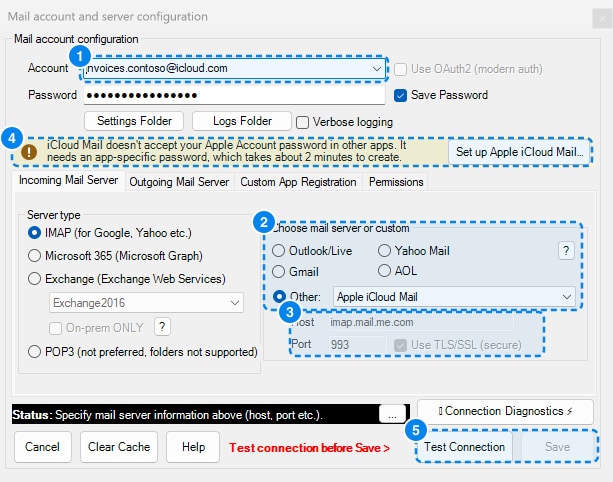
- 1Account: your email address. The box is also a dropdown of your saved accounts, so you can switch to another account's settings without closing the window. If you have unsaved changes, it asks whether to save or discard them first, and the main window switches to that account too.
- 2Server type and mail server: pick Gmail, Outlook/Live, Yahoo Mail or AOL, or pick Other and choose your provider from the list. The list is in alphabetical order and ends with Custom host and port (IMAP or POP3) for any other mail server. The program usually picks the provider for you from your address.
- 3Host, Port and TLS: filled in for the provider you picked. Leave them as they are unless your provider tells you otherwise. For Bluehost and IceWarp, the host starts as
mail.followed by your domain: change it if your provider shows a different server. - 4Amber notice: appears when the provider needs something before it lets the program in, such as an app password or IMAP turned on. Click Set up <provider>… and follow the setup guide.
- 5Test Connection, then Save: the program signs in and reports the result on the Status line. Keep Save Password ticked if you want scheduled downloads to run without asking.
Which settings should I pick?
| Your email | Server type | Mail server | How you sign in |
|---|---|---|---|
| Gmail, Google Workspace | IMAP | Gmail | With Google in your browser. Turn on IMAP first if Gmail asks. |
| Outlook.com, Hotmail, Live | IMAP | Outlook/Live | With Microsoft in your browser |
| Microsoft 365 (work or school) | Microsoft 365 (Microsoft Graph) | – | With Microsoft in your browser. See Microsoft 365. |
| Exchange on your own server | Exchange (Exchange Web Services) | – | Your Windows or Exchange password. See Exchange (EWS). |
| Yahoo, AOL (including Verizon.net) | IMAP | Yahoo Mail or AOL | App password: click Set up… |
| iCloud, Zoho, Proton, Fastmail, GMX, GoDaddy, IONOS and others | IMAP | Other: pick your provider | Depends on the provider: click Set up… |
| Your own domain (you@yourcompany.com) | Just type the address. The program looks up your domain's mail records to find the provider: Google Workspace selects the Gmail settings, and for Microsoft 365 it offers Use Microsoft 365. Hosting providers in the list are picked automatically. | ||
| Any other mail server | IMAP (or POP3) | Other: Custom host and port | Enter the host and port from your provider's help pages, usually port 993 with Use TLS/SSL ticked. Prefer IMAP to POP3. |
Yahoo, iCloud and other providers: app passwords and setup guides
Many providers don't accept your regular password in other programs. Instead they need an app password (a separate password for one program), or they need access for other programs turned on first. The program knows what each provider needs and walks you through it:
- Enter your email address in the mail server settings. Your provider is picked under Other (or Yahoo Mail / AOL). If it isn't, pick it from the list yourself.
- Click Set up <provider>… in the amber notice. The setup guide opens.
- Follow the guide's steps (pictured below), then click Save in the mail server settings.
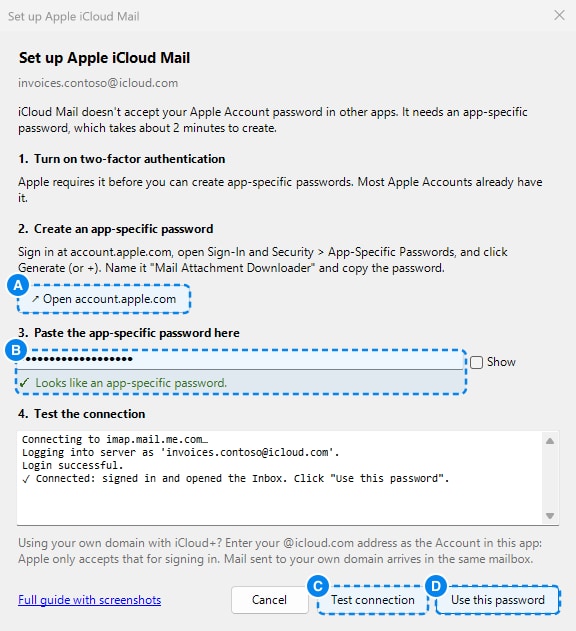
- AOpen the provider's page: the buttons take you straight to the right page, for example to create the app password. Name it "Mail Attachment Downloader" so you can recognize it later.
- BPaste the password: the guide checks that it looks right. For example, Yahoo and AOL app passwords are 16 letters, and Apple's look like
abcd-efgh-ijkl-mnop. If it says the password doesn't look right, you probably pasted your regular password. - CTest connection: signs in and opens your Inbox, and says what went wrong if it can't.
- DUse this password: puts the password and server into the mail server settings. The status line then says "Connected to <provider>. Click Save to keep these settings."
Changed your provider password? Some providers cancel all app passwords when you change your main password (Apple does). Create a new app password and enter it with the setup guide again.
What each provider needs
All of these connect with IMAP on port 993 with SSL unless noted. The setup guide in the program has the same steps, with buttons that open each page.
| Provider | What you need | IMAP server |
|---|---|---|
| Yahoo Mail (also ymail.com, rocketmail.com) | An app password: in Yahoo Account Security, click Generate app password. Use a browser you normally use for Yahoo, not a private window, or Yahoo may not offer it. | imap.mail.yahoo.com |
| AOL Mail (also aim.com, verizon.net) | An app password: in AOL Account Security, click Generate app password. Verizon.net addresses sign in at AOL. | imap.aol.com |
| Apple iCloud Mail | An app-specific password (needs two-factor authentication): at account.apple.com, open Sign-In and Security > App-Specific Passwords. With your own domain on iCloud+, enter your @icloud.com address as the Account. | imap.mail.me.com |
| Zoho Mail | IMAP access turned on (Zoho Mail: Settings > Mail Accounts > IMAP Access), and an app-specific password if your account uses two-factor authentication. Pick where your account was created in the guide. | imappro.zoho.com (own domain) or imap.zoho.com; .eu, .in, .com.au for other regions |
| Proton Mail | Proton Mail Bridge (paid Proton plans) running on this computer, set to SSL, with its certificate trusted. Use the password Bridge shows under Mailbox details, not your Proton password. | 127.0.0.1 port 1143 |
| Fastmail | An app password: Settings > Privacy & Security > Manage app passwords and access, with access to Mail. | imap.fastmail.com |
| GMX Mail | POP3 & IMAP access turned on in GMX's settings, and an app-specific password if two-factor authentication is on. | imap.gmx.com or imap.gmx.net (Germany, Austria, Switzerland) |
| Mail.com | POP3 & IMAP access turned on in mail.com's settings (not all plans include it). | imap.mail.com |
| Yandex Mail | IMAP turned on (Settings > All settings > Email clients) and an app password from Yandex ID. | imap.yandex.com |
| Mail.ru | A password for external applications: Security > Passwords for external applications. | imap.mail.ru |
| GoDaddy Workspace Email | Your email password (the one for GoDaddy Webmail), not your GoDaddy account password. If your GoDaddy email is Microsoft 365, use Microsoft 365 instead. | imap.secureserver.net |
| IONOS (1&1) | This mailbox's own password, not your IONOS customer login. Pick your IONOS country in the guide. | imap.ionos.com, imap.ionos.de or imap.ionos.co.uk |
| Titan Email | "Enable Titan on other apps" turned on in Titan webmail (Settings > Security), then your Titan password. | imap.titan.email |
| Hostinger Email | This mailbox's password (set it in hPanel under Emails). If it's Titan, pick Titan Email. | imap.hostinger.com |
| Bluehost and other cPanel hosting | This mailbox's password. Check the server name under Email > Email Accounts > Connect Devices. | Usually mail.yourdomain.com |
| Namecheap Private Email | Your webmail password, or an application password if two-factor authentication is on. | mail.privateemail.com |
| Rackspace Email | Your webmail password, or an app password if the mailbox uses multi-factor authentication. | secure.emailsrvr.com |
| Neo Mail, Spacemail | The password you sign in to their webmail with (for Spacemail, not your Spaceship account password). | imap.neo.space, mail.spacemail.com |
| Mailbox.org, Posteo, Hushmail | Your regular password (Hushmail: your passphrase, on plans that include IMAP). Mailbox.org needs an application password if two-factor authentication is on. | imap.mailbox.org, posteo.de, imap.hushmail.com |
| IceWarp | Your IceWarp password. The server is your organization's IceWarp webmail address. | Usually mail.yourdomain.com |
When the provider turns down the password
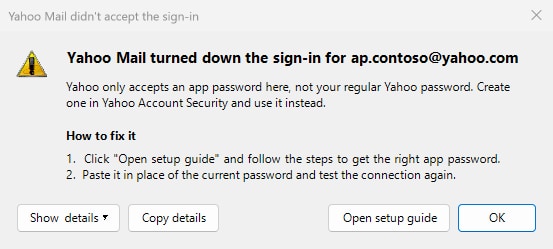
If a test or a download fails because the provider refused the password, for example a regular Yahoo password instead of an app password, the program explains what the provider needs. It works out the reason from what the server did, so this works even when the server answers in German, French or another language.
Gmail, Outlook.com and Microsoft 365: signing in with your browser
These accounts sign in with OAuth: you sign in on Google's or Microsoft's own page, and the program never sees your password. When you click Test Connection (or the first time you download):
- The Authorization required window opens and shows the account being set up, then your web browser opens.
- Choose the same account on the sign-in page, not another account your browser is signed in to.
- Allow every permission. On Google, tick every checkbox before clicking Continue: unticked boxes aren't granted.
- Go back to the program. It continues by itself once you've signed in.
If the program says "Some permissions weren't granted", follow this help article. For work or school accounts, the window's Copy for IT button copies the details your administrator needs. Read how we handle your data in our security and privacy policies.
PRO Organizations that don't allow our app, or that run the program unattended, can sign in through their own app registration instead, in the Custom App Registration tab of the mail server settings. It works for Microsoft 365 work or school accounts with Microsoft Graph, Exchange or (since build 1030) IMAP, where app-only access with a client secret doesn't depend on a user's sign-in, and for Gmail / Google Workspace with IMAP (since build 1030). Setup guides: Microsoft 365 (Entra) and Google Workspace. More in Security.
Microsoft 365 (Exchange Online) with Microsoft Graph
For Microsoft 365, Exchange Online and work or school Outlook accounts, choose Microsoft 365 (Microsoft Graph) as the Server type. You can also use it for personal Outlook.com accounts instead of IMAP.
Account: usually your email address (someone@contoso.onmicrosoft.com), or your username or domain\username. Tick Shared mailbox access if this is a shared mailbox.
If you type an address on your own domain and its mail is hosted by Microsoft 365, the program offers Use Microsoft 365 to fill this in for you.
Show the instructions for Exchange on your own server or legacy Exchange Web Services (EWS)
Exchange Web Services is an older connection type that Microsoft is retiring for Exchange Online. Use Microsoft Graph above for Microsoft 365. EWS still works best with older Exchange servers on your own network.
- Server TypeChoose Exchange (Exchange Web Services). Tick On-prem ONLY for an Exchange server on your own network.
- AccountUsually your email (someone@contoso.onmicrosoft.com) OR username OR domain\username
- Domain (optional)Leave blank if domain is already specified as part of the Account (i.e. user@domain.com OR domain\username).
- Email addressIf you only specified username or domain\username in the Account portion and not an email address like user@domain.com, you will need to specify the full email address as well when choosing Autodiscover option.
- EWS / Exchange service URLIf you choose NOT to use Autodiscover, specify the full EWS URL eg. https://mail.server/EWS/Exchange.asmx. This URL usually ends with EWS/Exchange.asmx.
If you can't get Exchange working, contact support and tell us what you see. You can also try IMAP as the Server type with Microsoft's IMAP settings for Outlook.com and Microsoft 365.
Check that your account is set up correctly
Before you rely on scheduled downloads, run through this list:
- Test Connection succeeded and the Status line says you're connected. Then click Save.
- Save Password is ticked, so scheduled downloads don't stop to ask for it.
- The Save location exists and you can write to it. For a network folder, type a
\\server\share\folderpath rather than a mapped drive letter. - Your first Connect and Download finished with ticks next to the files. Files with a cross, or rows in yellow, failed: see why in the Download History tab.
- In the Download History tab, tick Failures only to see anything that went wrong, or filter by Account and Session to see a single run. Every run is recorded, including sign-in and connection errors.
Connection or sign-in problems?
- Read the message. Sign-in problems now say what the provider needs and what to do. For app-password providers, click Open setup guide. For Gmail and Microsoft accounts, see Signing in with your browser.
- Open Connection Diagnostics. Click 🩺 Connection Diagnostics in the mail server settings (or the Logs tab). It shows each stage of the latest connection and sign-in with timings, errors and TLS certificate details, and the error history. Passwords, tokens and secrets are never shown or included.
- Check with your provider or IT. Make sure IMAP (or POP3 or Exchange) is turned on for your mailbox, and that a firewall or antivirus isn't blocking the connection.
- Search the help desk for your error.
- Send us a bug report. Turn on Verbose logging in the Logs tab, try again so the problem happens, then click 🐞 Submit a bug report.... Describe what happened and attach screenshots. The report includes the connection diagnostics and the logs, zipped, and emails them to support@gearmage.com.
Tip: if you changed several settings after a failed test and it still doesn't connect, delete the account with the trash button next to the Account in the main window and add it again with Add account. This clears any cached settings.
Frequently Asked Questions
Why does it download all my mail the first time I run it?
The program identifies new mail based on when it last successfully downloaded attachments.
So when you run it for the first time, since no attachments have been downloaded yet, it will download all mail attachments in your email inbox after which it will only scan for mail attachments that arrive from thereon (including read and unread mail).
The default setting will only download messages since last download including unread mails that have not been downloaded by the program. IMPORTANT: If you switch this setting to All mail at any time, any state will be lost and the next time you select messages since last download it will download from the start again. To avoid this, select a date filter (see FAQ below titled "How do I download from a given date?").
Subsequent runs by clicking the 'Connect And Download' button will download remaining mail attachments that have not been downloaded yet until it has downloaded all attachments till the present day.
If a run is interrupted (you cancel it, the network drops or the computer goes to sleep), the next run resumes where it stopped. Emails that failed to download are retried on later runs for up to 7 days.
How do I download from a given date?
If you don't want to wait to download all email attachments the first time, set the 'start date' from which you want to download your attachments in the Search tab. Leave the 'end date' unchecked to indicate that there is no end date.
How do I re-download the same attachments?
If you you want to re-download the same attachments that the program had already downloaded in the past, choose Search -> Check In -> All mail. You may also want to check the Inline Content checkbox if you want to download attachments that are inlined. For certain types of mail servers this will be checked by default.
How secure is the application?
The application tries to default to the most secure means of connection and authentication available - see more info about security. Gmail, Outlook.com and Microsoft 365 sign in with OAuth in your browser, so the program never sees your password. Providers such as Yahoo, AOL and iCloud don't offer OAuth to other programs, so they need an app password instead: a separate password you can cancel at any time without changing your main one. See app passwords and setup guides.
Google blocked the sign-in or sent me a security alert
Google doesn't accept passwords from other programs. Gmail and Google Workspace accounts sign in with Google in your web browser instead: make sure Gmail is selected in the mail server settings, click Test Connection, and sign in when your browser opens. See Signing in with your browser.
Google may send a "new sign-in" or "access granted" security alert the first time you allow the program. That's expected. More info about security
Having trouble connecting or authenticating?
Start with the message the program shows: it says what the provider needs. Then:
- Yahoo, AOL, iCloud, Zoho and the other providers under Other: click Set up <provider>… and follow the setup guide.
- Gmail, Outlook.com and Microsoft 365: see Signing in with your browser.
- Make sure IMAP (or POP3 or Exchange) is turned on for your mailbox. Your provider's help pages or your IT administrator can tell you.
- You may be behind a firewall, or antivirus software may be blocking the connection. Ask your IT administrator to check the host, port and TLS settings and that you can reach the mail server.
Still stuck? Follow Connection or sign-in problems, then send us a bug report from the program.
I'm using gmail and some attachments aren't being downloaded.
Some attachments are inlined, check the 'Inline attachments' checkbox in the Search tab. If the attachment still doesn't download, contact issues@gearmage.com.
Why is Selected Folders grayed out?
Some mail servers only support the POP3 mail server protocol.
The POP3 protocol inherently does not support folders whereas the IMAP protocol does.
To overcome this, first, make sure that your mail server supports IMAP and then change the protocol via the Settings button to IMAP.
Setting the date doesn't seem to work
If you are using POP3 (in the settings dialog for the account, see if POP3 is selected), the program will still need to scan/download (and throw away) attachments from the start of time even if the date is set.
File type limitations
A format of attached files that is sent by Outlook (TNEF) is not supported if your mail server does not convert them. These will be ignored by the program.
I see [THROTTLED] in the Status, what is that?
Some email providers like Gmail will end up throttling your connection if we end up processing too many requests for a given email account.
When a provider's limit is reached, the program shows the limit with advice. For Gmail's daily download (bandwidth) limit, the run stops and keeps its place, and the next run after the limit resets continues from there.
Where are the settings stored?
The settings are stored in the users %AppData%\MAD folder based on the logged on Windows user. To open it, go to the Logs tab and click Settings Folder under Client. From there you can also save the whole folder as a zip file, for a backup or to send to support. Passwords aren't stored in plain text.
My password works in webmail, but the program says it's wrong
Many providers only accept an app password in other programs, or need IMAP access turned on first. Yahoo, AOL, iCloud, Fastmail, Yandex and Mail.ru always need an app password, and others need one when two-factor authentication is on. Pick your provider in the mail server settings and click Set up <provider>…: the guide shows exactly what to do. See app passwords and setup guides.
Where can I see what was downloaded, or what failed?
Open the Download History tab next to Current Status. Every run is recorded, including sign-in, connection and folder errors. Filter by Account or Session (a single run), tick Failures only to see what went wrong, or type in the search box to find a file. History is kept for 30 days by default; you can change this, or clear it with Clear history....
Folders in the folder tree also have a menu that opens that folder's history.